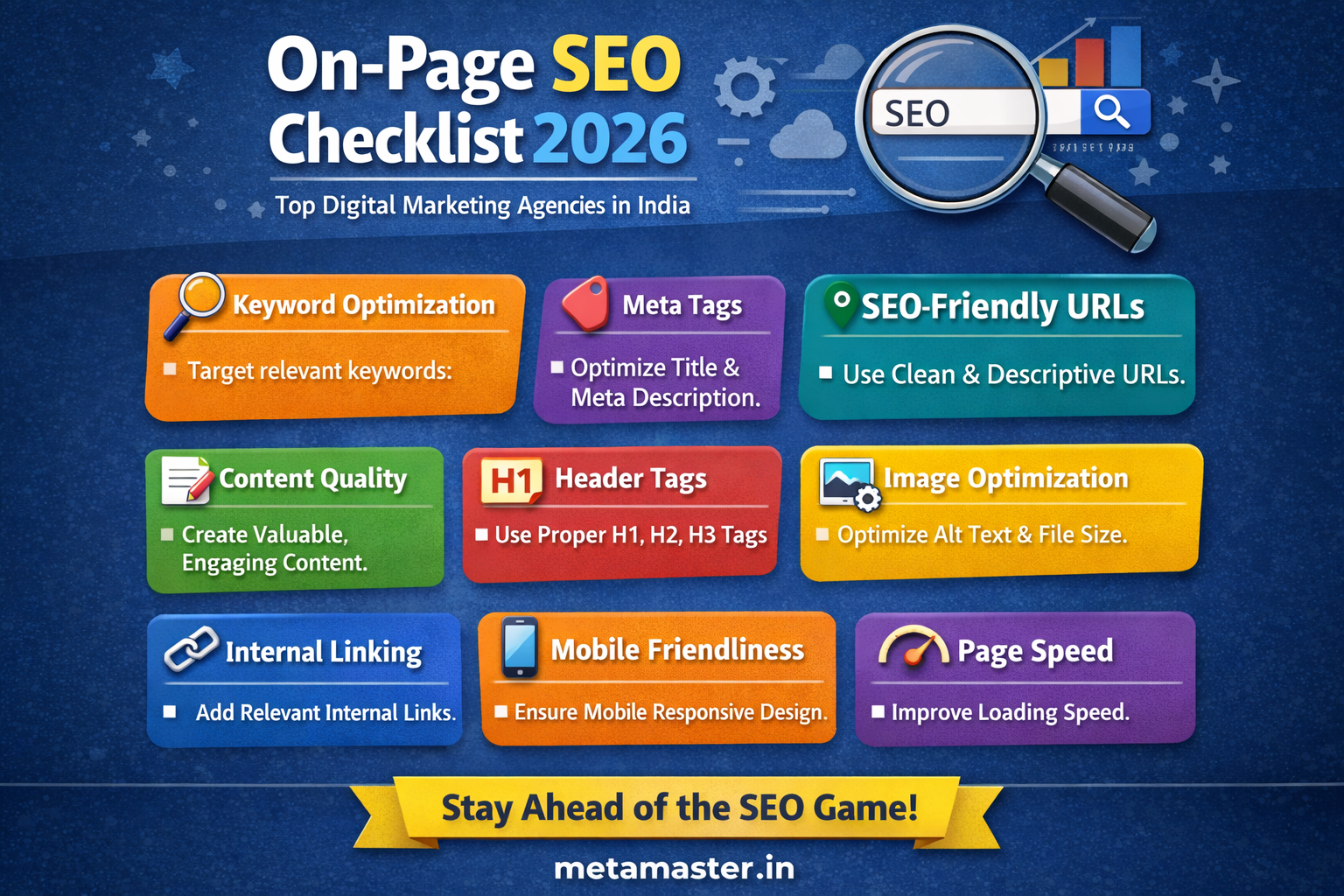
Why On-Page SEO Still Wins in 2026
Ranking on Google in 2026 is not about tricks — it is about trust signals, structured content, and genuine user value.
Search engines have evolved far beyond keyword matching. Today, they evaluate:
- Intent alignment — does your page truly answer what the user is searching for?
- Content authority — is your information accurate, deep, and trustworthy?
- Technical precision — is your page fast, crawlable, and structurally sound?
- User experience — do visitors stay, engage, and convert?
This checklist breaks down every critical on-page factor into a practical, repeatable system. Whether you are optimising an existing page or building a new one from scratch, follow this process every single time.
Step 1: Intent-Based Keyword Research
Before writing a single word, you need to understand why someone is searching — not just what they are searching.
Google classifies search intent into four categories:
- Informational — the user wants to learn (e.g. "what is on-page SEO")
- Navigational — the user wants a specific site (e.g. "Ahrefs login")
- Commercial — the user is comparing options (e.g. "best SEO tools 2026")
- Transactional — the user wants to buy or act (e.g. "hire SEO agency India")
How to do it right
- Search your target keyword on Google and study the top 5 results
- Note what format dominates — listicles, guides, product pages, videos?
- Identify the exact sub-questions Google surfaces in PAA (People Also Ask)
- Map those questions to your content sections
- Use tools like Ahrefs, Semrush, or Google Search Console to validate search volume and difficulty
Pro tip: If the top results are all listicles and you write a long-form essay, you will not rank — regardless of quality.
Step 2: Meta Title Optimisation
Your meta title is the single most important on-page SEO element. It directly affects your click-through rate and your ranking position.
Rules for a high-performing meta title
- Keep it between 50–60 characters (longer gets truncated in SERPs)
- Place your primary keyword as close to the start as possible
- Include a power word — Complete, Ultimate, Proven, Exact, Free
- Add a year if the content is time-sensitive (2026)
- Include your brand name at the end separated by a pipe |
Examples
Weak: On Page SEO Tips for Website
Strong: On-Page SEO Checklist 2026: 14 Steps to Rank Higher | MetaMaster
What to avoid
- Keyword stuffing (e.g. "SEO SEO Checklist Best SEO 2026")
- Clickbait that mismatches the actual content
- Duplicate titles across multiple pages
- All caps or excessive punctuation
Quick Win
Quick Win
Test your titles before publishing. Use the free SERP Simulator by Portent to preview exactly how your title and description will appear in Google search results. A title that looks perfect in your CMS can get cut off in the actual SERP.
Step 3: High-CTR Meta Description
Google does not use the meta description as a ranking factor — but it directly affects your click-through rate, which does influence rankings.
Think of your meta description as a Google Ad for your organic listing.
Framework
[Pain point or question] + [What they will get] + [Why trust you] + [CTA]
Example: Struggling to rank on Google in 2026? Follow our step-by-step on-page SEO checklist — used by top agencies in India — to optimise every page for higher rankings and more organic traffic. Start now.
Rules
- 130–155 characters maximum
- Include your primary keyword naturally
- Use active voice and action verbs
- End with a soft call to action — "Learn more", "See the checklist", "Start today"
- Never duplicate descriptions across pages
Note: Google rewrites meta descriptions roughly 70% of the time based on the query. Write it anyway — it still shows in cases where your page matches the search closely.
Step 4: Heading Structure & Content Hierarchy
Your heading structure is the skeleton of your page. It tells search engines how your content is organised and helps users navigate.
The correct hierarchy
H1 — Page title (only ONE per page)
  H2 — Major section
    H3 — Subsection under H2
      H4 — Detail under H3 (use sparingly)
Rules
- One H1 only — it must contain your primary keyword
- H2s should cover your main topics — include secondary keywords naturally
- H3s are for depth — answer sub-questions within each H2 section
- Keep headings descriptive and specific — avoid vague labels like "Introduction" or "More Info"
- Front-load keywords in headings where natural
Pro structure tip
Before writing, map your headings in a document outline first. If your H2s do not collectively answer the full search intent, your content structure is incomplete — no amount of writing will fix a broken skeleton.
Step 5: URL Structure & Content Depth
URL Optimisation
Your URL is a ranking signal and a trust signal. Users and crawlers both read it.
Rules:
- Short, descriptive, keyword-rich
- Use hyphens, never underscores
- Remove stop words (a, the, and, for, in)
- Subfolder structure should reflect content hierarchy
Example:
- ❌
yoursite.com/blog/p?id=4829 - ❌
yoursite.com/on_page_seo_checklist_for_2026_complete_guide - ✅
yoursite.com/blogs/on-page-seo-checklist-2026
Content Depth
Thin content is one of the most common causes of ranking failure. Google's Helpful Content System actively demotes pages that:
- Provide little original information
- Repackage existing content without adding value
- Exist primarily for search engines rather than readers
What "deep" content actually means in 2026:
- Coverage — addresses the topic fully, including related subtopics
- Specificity — uses concrete examples, data, and step-by-step instructions
- Originality — includes perspectives, case studies, or data not found elsewhere
- Recency — reflects the current state of the topic, not 2019 best practices
- Trust — cites sources, includes author expertise, links to authoritative references
Aleyda Solis, International SEO Consultant
The best on-page SEO is invisible to the reader. When your structure, intent alignment, and content quality are all working together, the reader just experiences a page that perfectly answers their question.
— Aleyda Solis, International SEO Consultant
Step 6: Core Web Vitals & Technical SEO
Technical on-page factors are often the fastest wins — fix them once and every page benefits.
Core Web Vitals (Google's page experience signals)
| Metric | What it Measures | Target | |--------|-----------------|--------| | LCP (Largest Contentful Paint) | Loading speed of main content | < 2.5 seconds | | INP (Interaction to Next Paint) | Responsiveness to user input | < 200ms | | CLS (Cumulative Layout Shift) | Visual stability | < 0.1 |
Quick technical checklist
- ✅ Page loads under 2.5s on mobile (test with PageSpeed Insights)
- ✅ Images are next-gen format (WebP or AVIF) and lazy-loaded
- ✅ No render-blocking JavaScript or CSS in the critical path
- ✅ Font display set to
swapto prevent invisible text - ✅ Mobile viewport configured correctly
- ✅ HTTPS enabled with no mixed-content warnings
- ✅ Canonical tag present and correct
- ✅ Robots meta tag set to
index, follow - ✅ Structured data (schema) implemented
- ✅ Hreflang tags for multilingual pages (if applicable)
Step 7: Schema Markup & Internal Linking
Schema Markup
Schema markup (structured data) tells Google exactly what your content is — an article, a product, a FAQ, a how-to guide. Pages with schema earn rich results in SERPs, which dramatically increase CTR.
Essential schema types for agency blogs:
ArticleorBlogPosting— for every blog postFAQPage— when your post answers common questionsHowTo— for step-by-step guides like this oneBreadcrumbList— for navigational contextOrganization— for your agency homepage
Minimum required fields for BlogPosting:
{
  "@context": "https://schema.org",
  "@type": "BlogPosting",
  "headline": "On-Page SEO Checklist 2026",
  "author": { "@type": "Person", "name": "Yasmeen" },
  "datePublished": "2026-01-15",
  "dateModified": "2026-04-20",
  "publisher": { "@type": "Organization", "name": "MetaMaster" }
}
Internal Linking Strategy
Internal links distribute PageRank across your site and help Google understand your content architecture.
Rules:
- Every new blog post should link to at least 3 existing pages
- Prioritise linking to your pillar pages (high-value service/category pages)
- Use descriptive anchor text — never "click here" or "read more"
- Add contextual links mid-paragraph where they add genuine value
- Check for and fix orphan pages — pages with zero internal links pointing to them
Internal linking structure for an agency:
Blog Post → Service Page (SEO Services)
Blog Post → Related Blog Post
Blog Post → Case Study
Service Page → Blog Post (supporting content)
Common On-Page SEO Mistakes to Avoid
Even experienced teams make these errors. Audit your existing pages against this list.
Critical mistakes
- ❌ Keyword stuffing — forcing keywords unnaturally damages readability and triggers spam filters
- ❌ Duplicate content — same or near-identical content on multiple URLs confuses crawlers and splits ranking signals
- ❌ Missing or duplicate title tags — every page must have a unique, optimised title
- ❌ Ignoring mobile experience — Google indexes mobile-first; a broken mobile layout tanks your rankings
- ❌ Slow page speed — every 100ms delay reduces conversions by ~1% and hurts ranking
- ❌ Images without alt text — lost ranking opportunity and an accessibility failure
- ❌ No schema markup — you are leaving rich results on the table
- ❌ Shallow content — 300-word posts cannot compete with comprehensive, expert-level resources
- ❌ Broken internal links — waste crawl budget and degrade user experience
- ❌ Ignoring search intent — the most polished page will fail if it does not match what the user actually wants
How to audit fast
- Run your site through Screaming Frog (free up to 500 URLs)
- Check Google Search Console → Coverage and Page Experience reports
- Use PageSpeed Insights on your top 10 pages
- Manually review your top 5 landing pages against this checklist
Ready to Rank?
Ready to Rank?
On-page SEO is a system, not a one-time task. Apply this checklist to every new page before publishing, and run a quarterly audit on your existing content.
If you want MetaMaster to handle your complete SEO strategy — from technical audits to content creation to performance tracking — get in touch with our team. We have helped brands across India achieve 3–10× organic growth in under 12 months.